-
Types of Plasters
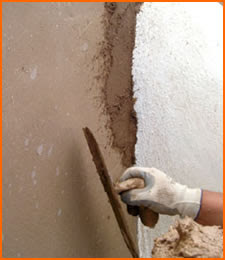 The various types of plasters used for plastering are,
1. Lime plaster (or Lime Mortar): When lime forms the building material. The plaster is called ‘Lime plaster’. It is a mixture of equal proportions (1 Lime : 1 Sand) and these materials are ground mechanically in a mortar mill to form a paste of required consistency. ‘Sand’ forms the greatest proportion of a plaster and also controls the plaster properties, such as shrinkage, porosity, strength, adhesiveness, etc. Fine sand is generally used for making the plaster but it should not be that fine such as to pass more than 5% through a 100-mesh sieve or more than 20% through a 50-mesh sieve. Sand to be used for plaster work should be clean, sharp and free from all deleterious material. Water to be used should be clean and fit for drinking purposes.
For plaster work fat lime or poor lime is recommended, because the hydraulic lime flakes slowly and results in damaging of plastered surfaces by blistering (called blowing) at a later stage.
Sometimes, to improve the strength properties of lime mortar, a suitable quantity of cement is added, and this plaster is mainly used for external work. In order to improve building properties of lime plaster, ‘gugal’ (a kind of fragrant gum) about 1.60 kg / m3 of mortar, is added when the mortar is being ground. In order to improve adhesive and tensile properties of lime mortar, sometimes, small quantities of chopped hemp (i.e., vegetable fibres) are added to the lime mortar. The quantity of hemp is usually about 1 kg / m3 of mortar. The lime mortar thus prepared is usually kept for 2 days before use.
2. Cement Plaster (or Cement Mortar): When cement forms the building material, the plaster is called ‘Cement Plaster’. It is an intimate mixture of portland cement and sand with required water to make a plastic mass. It consists of the usual proportions of 1 cement : 4 sand, though higher proportions can be used depending upon the nature of work. The ingredients are first thoroughly mixed in dry conditions and then water is added to form a paste of required consistency. The mixing of materials is done by hand on a water-tight platform and plaster of one bag of cement is prepared at a time. This prepared mortar for plastering should be consumed with in 30 minutes after the addition of water.
3. Mud Plaster: This mud plaster is prepared is prepared from equal volumes of well tempered clay or brick earth and of chopped straw, hay, loose soil or hemp and cow dung. All these ingredients are thoroughly mixed and left for about 7 days with a large quantity of water. This is mixed again thoroughly till it comes to the desired consistency of mortar.
4. Water-Proof Plaster or Mortar: This mortar consists of 1 part of cement, 2 parts of sand and the pulverized alum at the rate of 12 kg / m2 of sand. To this dry mix, the soap water containing about 75 gm of soft soap / litre of water, is added to obtain the waterproof mortar.
Find More About,
Plastering
Objectives of Plastering
Terms used in Plastering
Tools Used for Plastering
Lime Plastering
Cement Plastering
Stucco Plastering
Mud Plastering
Subscribe to:
Post Comments (Atom)


