-
Mud Plastering
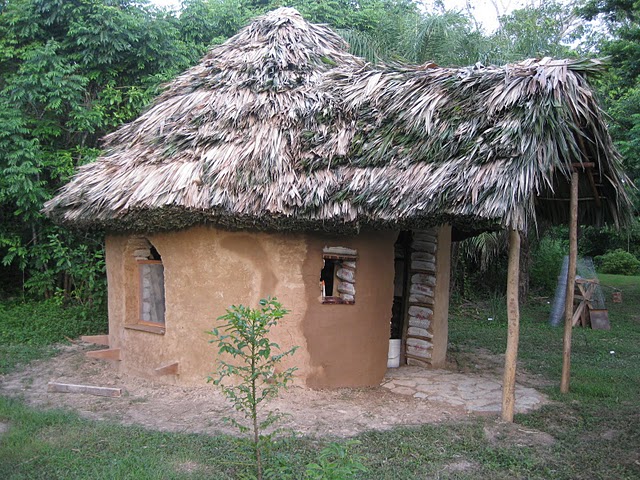
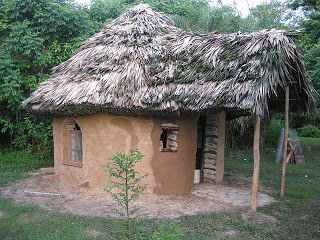 Mud Plastering is the cheapest type of plastering, generally employed in the construction of village houses, temporary sheds and structures of temporary importance. Besides being cheap, it provides insulation against heat and keeps the house cool for comfortable living. Mud plastering in two coats is carried as below:
(i) The mud plaster, consisting of well-tempered clay, chopped straw, hemp and cow dung, is prepared in homogeneous mass, as described earlier.
(ii) The preparation of wall surface and ground work for plastering is done exactly in the same manner as that for lime plastering or cement plastering. That is, for plastering, the wall surface is first prepared by knocking off projections, raking-out joints, wetting with water, etc., and then vertical screeds (15 cm in width), are formed on the wall surface at suitable intervals.
(iii) The first coat is then applied in a thickness of 12 mm by dashing the plaster or by placing the plaster in the spaces formed by the screeds. The surface is then finished by means of a straight edge and a wooden float.
(iv) After 24 hours of setting (but not drying) of the first coat, the second coat is applied in thickness of 6 mm.
(v) No curing is done in this case but the surface is given a wash of fine while earth, cow dung and cement in mix proportions of 3 : 2 : 1 respectively.
Find More About,
Plastering
Types of Plasters
Objectives of Plastering
Terms used in Plastering
Tools Used for Plastering
Lime Plastering
Cement Plastering
Subscribe to:
Post Comments (Atom)


