-
Crop Rotation
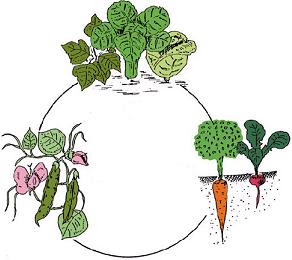 The term crop rotation is somewhat self explanatory. It implies that nature of the crop sown in a particular field is changed year after year.
Necessity for rotation
The necessity for rotation arises from the fact that soil gradually losses its fertility if the same crop is sown every year and the field has to be allowed to lie fallow in order to regain its fertility. The effect of fallow is obtained by rotation of crops.
All crops require similar type of nutrient for their growth but all of them do not take in the same
quantities or proportions; some crop favours certain plant nutrients and take them more than the others. Thus if a particular crop is grown year after year, the soil gets deficient in the plant food favoured by that crop. If different crops were to be raised there would certainly be more balanced fooding and soil deficient in one particular type of nutrient is allowed to recoupe.
Crop diseases and insect pests will multiply at an alarming rate, if the same crop is to be grown continuously. Rotation will check this disease.
A leguminous crop (such as gram) if introduced in rotation will increase nitrogen content of the soil thus increasing its fertility.
There could be deep rooted crops and shallow rooted crops in rotation and so they shall draw their food from different depths of soil. The soil will thus be better utilised. Rotation of crops in the long run is beneficial to the farmer and soil both as there would be a rotation of cash crops, fooder crops and soil renovating crops.
The following rotations have been found useful:
1. Introduction of groundnut in the usual cotton jowar rotation as per the experiments in Central Province, Hyderabad.
2. In Northern India, cotton is known to have improved when it follows berseen on fields manured with phosphate.
3. In Madras, Bajra when rotated with cotton has proved to be superior to Jowar being rotated with cotton.
4. Cotton gives good result after gram or fallow.
5. Wheat does well after-sugar-cane and gowara.
In general the rotation of the crops can be summarised as given below:
1. Wheat-great millet-gram
2. Rice-gram
3. Cotton-wheat-gram
4. Cotton-wheat-sugar-cane
5. Cotton-great millet-gram
The reason for gram being one in rotations is its being leguminous crop giving nitrogen to the field.
Subscribe to:
Post Comments (Atom)


