-
Solvents or Thinners
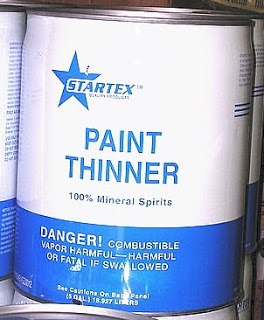 A ‘Solvent’ or ‘Thinner’ is a liquid which is mixed in a paint to make the paint thinner or of desired consistency so that it can be easily applied on the surface.
In addition to this basic function, a solvent, incidently, also performs the following functions in a paint:
(i) It helps the paint in penetrating through the porous surfaces being thinner at the time of application.
(ii) After applying the paint, the solvent evaporates and the resulting surface is more even and smooth.
(iii) It facilitates brushing and improves spreading power of the paint.
Thinners commonly used are the following:
(a) For oil paints :
(i) Turpentine
(ii) White spirit, and
(iii) Naphtha.
(b) For spirit laquers : Alcohol
(c) For cellulose paint : Ethylamyl acetate
(d) For distempers : Water
‘Turpentine’ is the most common thinner used in oil paints. Turpentine is a spirit obtained by distilling balsam, which is the resin or gum obtained from pine trees. Turpentine is an inflammable, volatile and colourless liquid with pungent smell. Turpentine is generally affected by whether and hence should only be used in interior work and in making varnishes. If at all it is required to be used for external work, then minimum quantity, which is just enough to make the paint workable, should be used. Turpentine can also be used to produce dull surface when required.
‘Benzine and Naphtha’ are thinners which are cheaper and are sometimes used as substitutes for turpentine.
Subscribe to:
Post Comments (Atom)


