-
Slump Test - Measurement of Workablity of Concrete

The apparatus for conducting the slump test consists of a metallic mould, in the form of a frustum of a cone, having the internal dimensions as,- Bottom diameter = 20 cm
- Top diameter = 10 cm
- Height = 30 cm
The thickness of the mould should not be thinner than 1.6 mm. The mould is provided with suitable guides, to lift vertically up. For tamping the concrete, a steel tamping rod 16mm dia, 0.6 meter long, with bullet end is used. Fig. shows the details of the slump.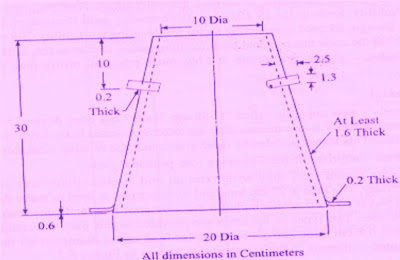

The internal surface of the mould is thoroughly cleaned and freed from superfluous moisture and any old concrete.The mould is placed on a smooth, horizontal, rigid and non-absorbent surface and filled in 4 layers, each approximately ¼ of the height of the mould. Each layer is tamped 25 times by the tamping rod, taking care to distribute the strokes evenly over the cross section. After the top layer has been rodded, the concrete is struck off level with a trowel and tamping rod.The mould is removed from the concrete immediately, by raising it slowly and carefully in a vertical direction. This allows the concrete to subside.This subsidence is referred as Slump of concrete. The difference in level between the height of the mould and that of the highest point of the subsided concrete is measured.This difference in height in mm is taken as Slump of Concrete.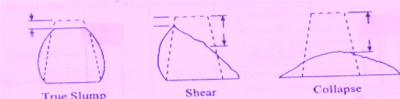
- The slump test gives fairly good consistent results for a plastic mix.
- This test is not sensitive for a stiff-mix.
- In case of dry-mix, no variation can be detected between mixes of different workability.
- In case of rich mixes, the value is often satisfactory, their slump being sensitive to variations in workability
- IS 456-2000 suggests that in the “very low” category of workability, where strict control is necessary, for example, pavement quality concrete, measurement of workability by determination of compacting factor will be more appropriate than slump and a value of 0.75 to 0.80 compacting factor is suggested.
- Despite many limitations, the slump test is very useful on site to check day-to-day or hour-to-hour variation in the quality of mix.
- An increase in slump may mean for instance, the moisture content of the aggregates has suddenly increased or there has been sudden change in the grading of aggregates.
- The slump gives the warning to correct the causes for change of slump value.
- The simplicity of the test is another reason, why this test is still popular in spite of the fact that many other workability tests are in vogue.


Subscribe to:
Post Comments (Atom)


