
-
Shotcrete or Gunite
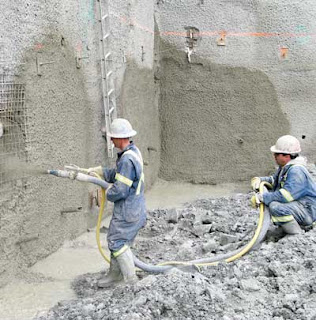 Shotcrete or Gunite can be defined as mortar conveyed through a hose and pneumatically projected at a high velocity on to a surface.
Recently the method has been further developed by the introduction of small sized coarse aggregates in to the mix deposited to obtain considerably greater thickness in one operation and also to make the process economical by reducing the cement content. Normally fresh material with zero slump can support itself without sagging or peeling off. The force of the jet impacting on the surface compact the material. Sometime use of set accelerators to assist overhead placing is practised. The newly developed "Redi-set cement" can also be used for shotcreting process.
There are two different process in use, namely the "Wet mix process" and the "Dry mix process". The dry mix process is more successful and it is generally used.
Dry mix process :
The stages involved in the dry mix process is given below,- Cement and sand are thoroughly mixed.
- The Cement/sand mixture is fed in to a special air-pressurised mechanical feeder termed as gun.
- The mixture is metered in to the delivery hose by a feed wheel or distributor within the gun.
- This material is carried by compressed air through the delivery hose to a special nozzle. The nozzle is fitted inside with a perforated manifold through which water is sprayed under pressure and intimately mixed with sand/cement jet.
- The wet mortar is jetted from the nozzle at high velocity on to the surface to be gunited.
- The dry mix methods makes use of high velocity or low velocity system. The high velocity shotcrete is produced by using a nozzle and a high air pressure to produce a high nozzle velocity of about 90 to 120 metres per second. This results in good compaction. The lower velocity gunite is produced using a large diameter hose for larger output, but the compaction will not be very high.
- In the wet mix process the concrete is mixed with water as for ordinary concrete before conveying through the delivery pipeline to the nozzle, at which point it is jetted by compessed air, on to work in the same way as that of dry mix process.
- The wet mix process has been generally discarded in favour of the dry mix process, owing to the greater success of the latter.

Subscribe to:
Post Comments (Atom)